Expense Ratios & P&L Requirements for Self-Employed Borrowers
Expense Ratios and P&L Requirements: The Numbers Underwriters Actually Use
By Rayce Robinson, Owner & Lead Mortgage Broker, Mid Florida Mortgage Professionals (NMLS #322615)
If you have followed this series (see links to other posts at the bottom), you already know that bank statement loans evaluate your monthly deposits rather than the net taxable income on your tax returns. What many business owners don't realize until underwriting begins is that gross deposits are only step one of the math.
Lenders never qualify you on 100% of your business revenue. They use an expense ratio to estimate net cash flow, and understanding how that number gets set is often the difference between getting approved or getting declined.
*************************************************************************************
What Is an Expense Ratio on a Bank Statement Loan?
An expense ratio is the percentage of gross revenue an underwriter automatically deducts from your bank deposits to account for day to day business operating costs. The remaining balance is your actual qualifying income for the mortgage.
The logic behind it is simple: gross deposits are not take-home profit. Because an underwriter reviewing bank statements doesn't have your Schedule C or corporate tax return to inspect itemized line items, they apply a standardized expense factor.
How the Calculation Works in Practice
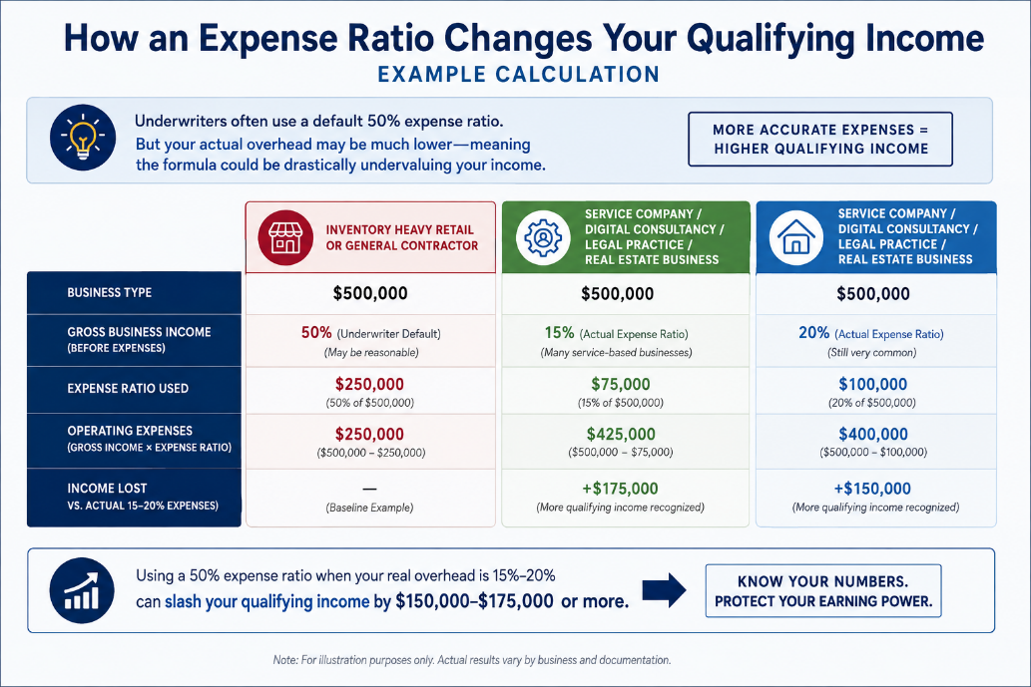
Most traditional lenders and rigid Non-QM programs default to a flat 50% expense ratio across the board, regardless of your industry.
Average Monthly Business Deposits: $20,000
Default 50% Expense Ratio Deduction: -$10,000
Qualifying Income Used for the Mortgage: $10,000/month
For an inventory heavy retail business or general contractor, 50% might be generous. But if you run a service company, digital consultancy, legal practice, or real estate business, your real operating overhead might only be 15% to 20%. Under a default 50% formula, the underwriter is slashing half your earning power on paper.
*************************************************************************************
Why a CPA or EA Profit & Loss Statement Changes the Game
You don't always have to accept an arbitrary 50% expense factor. Many specialized wholesale lenders allow you to document your real overhead using a third-party prepared Profit and Loss (P&L) statement.
If your actual overhead runs at 20%, a documented P&L allows the lender to qualify you on 80% of your deposits instead of 50%. On that same $20,000 per month revenue stream, your qualifying income jumps from $10,000 to $16,000 a month, instantly expanding your purchasing power.
Here is the catch: every wholesale lender approaches P&L documentation differently.
Standard Acceptors: Adjust the ratio directly to match a 3rd party P&L.
Capped Programs: Accept a P&L but refuse to allow expense ratios below a hard floor (e.g., 25% minimum).
CPA Letter Requirements: Require a one-page narrative letter from your CPA or Enrolled Agent attesting to business overhead margins.
Zero-Flexibility Lenders: Enforce a strict 50% default with no exceptions allowed.
This variance is why working with an independent broker matters. If we know your business runs lean, I match your file with a wholesale partner whose underwriting guidelines actively recognize low overhead P&Ls.
*************************************************************************************
A Real-World Example: Doubling Purchasing Power
A client of mine that worked in the financial industry and was engaging as a consultant in a very complex industry came to me after a retail bank turned them down. The bank applied an automatic 50% expense ratio against their monthly deposits, leaving them with a qualifying income too low for his goals of buying a home.
The client was a 100% remote business with no payroll, no warehouse, and minimal software expenses. Their actual overhead was well under 25%. We had their CPA provide a verified 12-month P&L on letterhead and submitted the file to a wholesale lender that underwrites to actuals.
Their qualifying income was recalculated and the debt-to-income ratio fell comfortably within program limits, and the loan closed on time. Same bank statements, same revenue, completely different outcome simply because we used the right guidelines.
What to Request from Your CPA or Tax Preparer
If we determine that documenting your actual expenses will benefit your loan file, here is what your tax professional needs to provide:
Matching Lookback Period: A P&L statement covering the exact same 12 or 24-month period as the bank statements submitted.
Professional Letterhead: Must be prepared and signed by an active CPA, Enrolled Agent (EA), or licensed tax preparer. Lenders do not accept self-prepared or software-generated spreadsheets.
Clear Expense Breakdown: Highlighting ordinary operating expenses versus owner draws or non-cash deductions like depreciation.
*************************************************************************************
Frequently Asked Questions
What is a typical expense ratio for bank statement mortgage loans?
The standard industry default is 50% of gross deposits. However, wholesale Non-QM programs allow ratios anywhere from 15% to 40% when supported by a CPA prepared P&L or tax professional letter.
Do all mortgage lenders accept a P&L to lower the expense ratio?
No. Retail banks and strict portfolio lenders usually stick to a single arbitrary percentage. Wholesale mortgage brokers have access to multiple lenders with varied underwriting rules, allowing us to select lenders that honor verified low overhead.
Can I create my own P&L using QuickBooks or Excel?
No. Underwriters will reject self-prepared P&L statements. To verify credibility without full tax returns, lenders require the statement to come from an independent CPA, Enrolled Agent, or licensed tax preparer.
Can commingled personal and business accounts use an expense ratio?
Yes, but commingled accounts require careful review. Some lenders reject commingled statements outright, while others apply a blended cash-flow analysis or deduct an additional personal expense factor.
*************************************************************************************
About Rayce Robinson & Mid Florida Mortgage Professionals
Rayce Robinson is the Owner and Lead Mortgage Broker at Mid Florida Mortgage Professionals | 235 S Central Ave, Oviedo, FL 32765 Click to open side panel for more information (NMLS #322615 / Corporate NMLS #1587074).
With over 20 years of local mortgage experience in Central Florida, Rayce specializes in helping homebuyers and owners across Oviedo (32765), Winter Springs, Chuluota, Geneva, and Seminole County secure low closing costs and competitive wholesale rates.
Mid Florida Mortgage Professionals is an independent wholesale mortgage brokerage owned by Rayce Robinson—completely independent and distinct from retail credit unions. As an independent broker, Rayce shops over 100 competing wholesale lenders on your behalf for Conventional, FHA, VA, Florida Hometown Heroes, DSCR, and Bank Statement loans.
Office Address: 235 S Central Ave, Oviedo, FL 32765
Google Business Profile: https://g.page/r/CfraNuIe8HMxEBM
Schedule a Call with Rayce Robinson: 321-377-4211
*************************************************************************************
Continue Learning
If you are Self Employed and researching loan programs, you will find this series helpful:
·Bank Statement Loans for Self-Employed Buyers in Central FL posted 9/1/2026
·Personal vs Business Bank Statements posted 9/3/2026
·Broker vs Bank or Credit Union posted 9/8/2026
·Expense Ratios / P&L Requirements
·DSCR Loans Explained posted 9/16/2026